AI & Agentic AI
The Agentic Enterprise: Moving Beyond Generative AI
How AI agents, enterprise knowledge, governance and cloud platforms are reshaping the architecture of the intelligent enterprise.
The Shift Beyond Generative AI
Generative AI has made it easier to draft, summarize and explore information through natural language. For an enterprise, the next question is what happens when a system can do more than produce an answer: select a tool, retrieve business context, propose an action and carry work across several steps.
That shift changes the architecture discussion. The organization must understand who authorized the task, which information the system can access, what actions it may perform and how a person can review or interrupt the work. A capable model is one part of this system; reliable execution depends on the surrounding controls and operating model.
What Is an Agentic Enterprise?
An agentic enterprise deliberately integrates AI-assisted actions into its people, processes, applications and information systems. Autonomy is bounded by the task. A service may be allowed to classify a request automatically while still requiring approval before changing a customer record or committing expenditure.
The useful starting point is a business workflow with a clear owner and a measurable outcome. Map the decisions, evidence and permissions it requires. This exposes where assistance can reduce repetitive work and where human judgment remains essential.
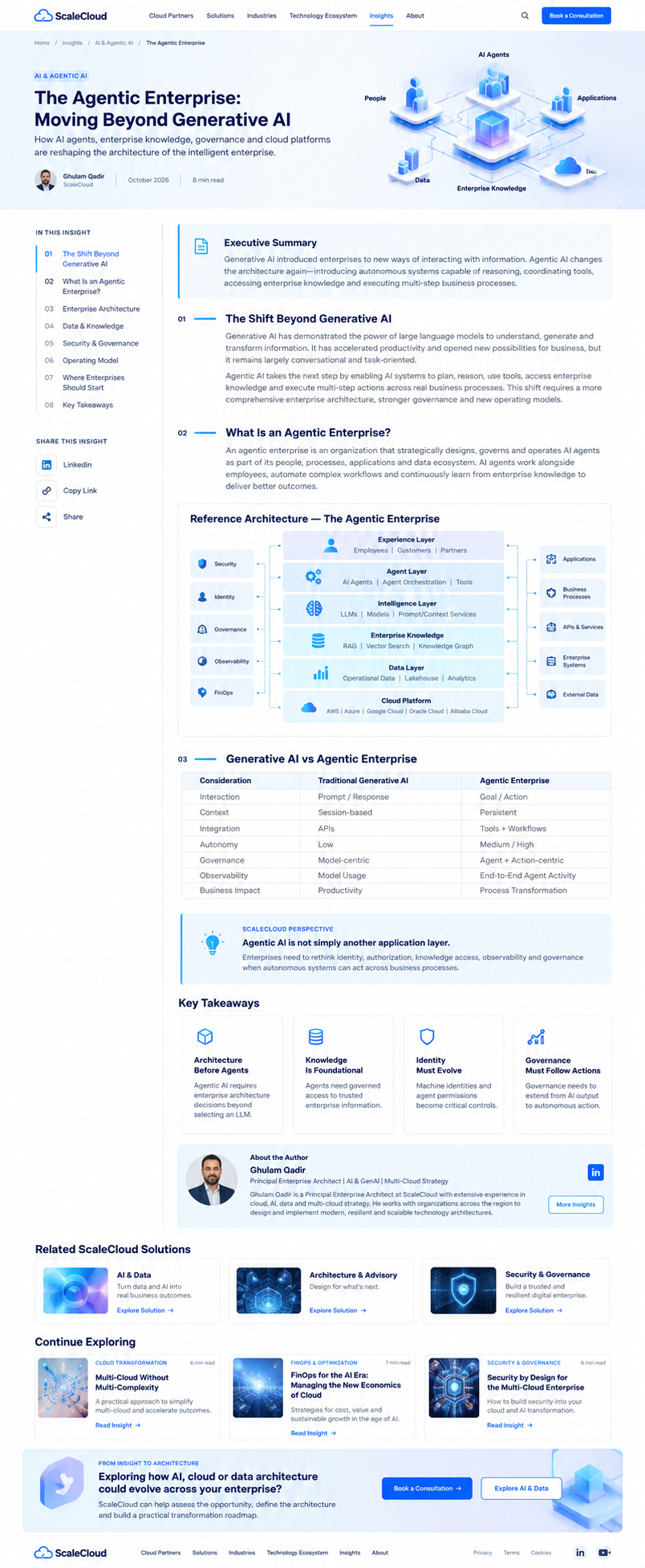
Reference Architecture — The Agentic Enterprise
Experience Layer
Employees · Customers · Partners
Agent Layer
AI agents · Orchestration · Tools
Intelligence Layer
Models · Prompt and context services
Enterprise Knowledge
Retrieval · Search · Knowledge graph
Data Layer
Operational data · Lakehouse · Analytics
Cloud Platform
AWS · Azure · Google Cloud · Oracle Cloud · Alibaba Cloud
Generative AI vs Agentic Enterprise
| Consideration | Traditional Generative AI | Agentic Enterprise |
|---|---|---|
| Interaction | Prompt and response | Goal and bounded actions |
| Context | Often session-based | Managed task state and business context |
| Integration | Information retrieval and APIs | Tools and coordinated workflows |
| Autonomy | User initiates each step | Delegated steps within explicit limits |
| Governance | Content and model controls | Content, permissions and action controls |
| Observability | Requests and model responses | Task decisions, tool calls and outcomes |
| Business impact | Assisted individual work | Potential workflow redesign |
Enterprise Architecture
Separate the experience, orchestration, knowledge and execution layers so each has a clear responsibility. Define a contract for every tool: accepted inputs, authorized actions, expected outputs, timeouts and failure behavior. Give irreversible steps an explicit approval boundary rather than allowing the model to infer permission.
Design for partial failure
A multi-step process can fail after some work has already completed. Track progress, make repeatable operations safe to retry and identify which changes need a compensating action. A clear failure path is as important as the successful demonstration.
Data & Knowledge
Knowledge quality starts with accountable source owners. Establish how information is classified, refreshed and withdrawn, and preserve access controls when it is retrieved. A concise answer is not sufficient if the source is stale or the recipient was never entitled to see it.
Best Practice — Keep evidence with the answer
Where practical, retain the source references and retrieval context needed to review a recommendation. Evaluate the system with representative questions, ambiguous cases and examples where it should decline to act.
Security & Governance
Treat each tool invocation as a privileged operation. Authorize it using the user’s identity, the task context and the service’s policy rather than instructions found inside retrieved content. External documents and messages can provide evidence, but they should not expand the system’s permissions.
Risk / Consideration — Permission can outlive context
A long-running task needs a policy for expired sessions, changed access rights and withdrawn approvals. Recheck authorization at sensitive action boundaries and keep a record of who approved the action.
Operating Model
Assign responsibility for the workflow, platform, information sources and incident response. Track successful outcomes alongside interventions, rejected actions and recovery effort. Include the resources consumed by retrieval, orchestration and retries when evaluating cost.
Define the unit of work and its acceptance criteria before deciding how much autonomy to delegate.
Where Enterprises Should Start
- Select a bounded workflow with an accountable owner and a reversible first step.
- Document the information, permissions and approvals needed to complete it.
- Evaluate outcomes against a representative set of cases, including failures.
- Pilot with human oversight and clear rollback procedures.
- Expand only when reliability, operating ownership and economics are understood.
Connect these decisions to your wider AI and data architecture, security model and enterprise architecture roadmap. Platform choice should follow the requirements of the workflow and the organization that will operate it.
Key Takeaways
Architecture Before Agents
Agentic AI requires enterprise architecture decisions beyond selecting a model.
Knowledge Is Foundational
Agents need governed access to trusted enterprise information.
Identity Must Evolve
Machine identities and agent permissions become critical controls.
Governance Must Follow Actions
Governance extends from AI output to authorized action.
Updated
Related ScaleCloud Solutions


Continue Exploring

Multi-Cloud
Multi-Cloud Without Multi-Complexity
Keep cloud choices deliberate by separating shared operating principles from platform-specific implementation decisions.
Read Insight →
FinOps
FinOps for the AI Era: Managing the New Economics of Cloud
Connect AI consumption to a defined workload, a measurable outcome and the teams that can influence the design.
Read Insight →
Cloud Security
Security by Design for the Multi-Cloud Enterprise
Make identity, data boundaries and operational responsibility explicit wherever enterprise workloads cross cloud environments.
Read Insight →From Insight to Architecture
Exploring how AI, cloud or data architecture could evolve across your enterprise?
ScaleCloud can help assess the opportunity, define the architecture and build a practical transformation roadmap.